Are SMM panels safe? They can be — if you choose a panel that never asks for your password, uses encrypted payments, and publishes refill terms, and if you accept that purchased engagement always violates platform rules. The risk is not one thing: it splits into payment risk, data risk, and account risk, and each has a specific defense.
This guide separates what is actually dangerous from what is merely against the rules, what is illegal from what is a terms-of-service issue, and gives you a seven-step protocol used by experienced buyers. It draws on scam reports and review patterns collected across the panels indexed on SMMCollection.
Key takeaways
- Buying engagement is rarely a crime, but it breaks platform rules — two different things.
- The US FTC bans selling fake indicators commercially, with penalties up to $51,744 per violation.
- A panel asking for your account password is a scam signal with no legitimate exception.
- Most real losses are payment losses: unvetted panels, no refunds, no recourse.
- A seven-step protocol — test orders, drip-feed, 2FA, tracked payments — removes most risk.
In this guide
- Are SMM panels legal?
- The real risks, ranked
- Red flags: when to walk away
- The password rule
- What platforms actually do about it
- The seven-step safety protocol
- Why independent reviews are your best defense
- Frequently asked questions
Are SMM panels legal?
Three separate questions hide inside this one:
Is running or using a panel a crime? In most jurisdictions, no. Selling and buying engagement is generally lawful commerce; panels operate openly with payment processors and registered businesses. Fraud enters only through specific conduct — stolen payment methods, hacked accounts as supply, or deceptive commercial claims.
Is it regulated? Increasingly, yes. In the United States, the Federal Trade Commission's 2024 rule on fake reviews and testimonials prohibits selling or buying fake social media indicators — followers or views from non-existent or hijacked accounts — when used to misrepresent commercial influence, with civil penalties up to $51,744 per violation, per the FTC's final rule announcement. Businesses inflating metrics to win customers carry more exposure than individuals decorating a profile.
Is it allowed by platforms? No. Every major platform bans inauthentic engagement in its terms — this is the rule you are certain to be breaking, and its enforcement is covered below.
The real risks, ranked
Ranked by how often each actually costs buyers money, based on the complaint patterns we see in panel reviews:
| Risk | Frequency | Worst case | Primary defense |
|---|---|---|---|
| Payment loss (no delivery, no refund) | Common | Wallet balance gone | Small test orders, vetted panels |
| Drop losses (counts vanish) | Common | 60–80% of purchase erased | Refill guarantees, organic tiers |
| Credential phishing | Occasional | Account stolen | Never share passwords |
| Card / data exposure | Occasional | Card fraud, spam | HTTPS, crypto or virtual cards, throwaway email |
| Platform penalties | Less common | Reach limits; rarely account loss | Drip-feed, moderate volumes |
Note the order: the mundane risks — losing $30 to a dead panel, watching half a follower package evaporate — occur far more often than the dramatic one (account bans). Guard your money first, your credentials always, and your metrics with written refill terms; retention math per quality tier is covered in organic vs. bot services.
Red flags: when to walk away
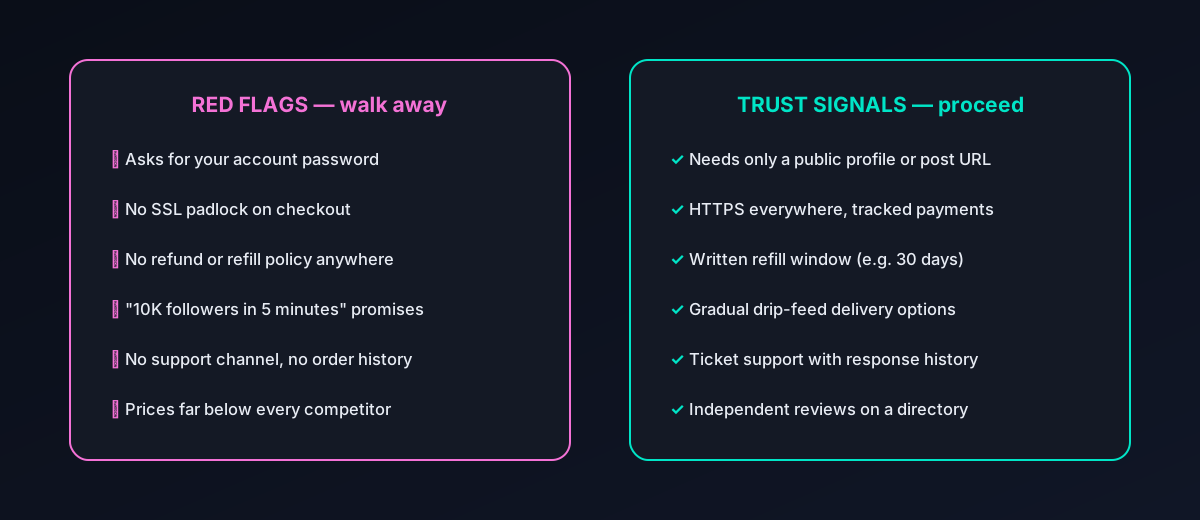
Any single item on the left side is disqualifying. Password requests and missing SSL are hard stops; the others are strong signals that compound. Google's Transparency Report shows over 95% of Chrome page loads are now encrypted, per Google's HTTPS report — a panel that has not managed HTTPS in 2026 is telling you how it handles your card data.
The password rule
The rule is absolute: a legitimate SMM panel never needs your password. Followers, likes, views, comments, and shares are all delivered to public URLs — the supply accounts act on your content from their side. The only services that genuinely require login access (account management, "grow my account for me" schemes) are precisely the ones you should never buy from an anonymous storefront, because handing over credentials converts a $10 purchase risk into total account loss. If any checkout field asks for a password, close the tab.
What platforms actually do about it
| Platform | Policy on purchased engagement | Typical enforcement |
|---|---|---|
| Instagram / Facebook | Banned as inauthentic activity | Fake-account purges; removed followers; reach limits |
| YouTube | Banned under fake engagement policy | Metric stripping; monetization review failure; strikes for repeat abuse |
| TikTok | Banned under integrity policies | View/like removal; For You suppression |
| X (Twitter) | Banned under platform manipulation rules | Follower removal; account restriction |
Enforcement is mostly aimed at supply rather than buyers: Meta actioned about 1.2 billion fake accounts in one quarter (Meta Transparency Center), and YouTube documents its fake engagement rules in YouTube Help. For buyers, the practical consequence is usually your purchased metrics disappearing — permanent account loss is rare and associated with extreme, repeated volume. That asymmetry is why drop risk belongs above ban risk in your planning.
The seven-step safety protocol
- Vet before funding. Check the panel on an independent directory with community reviews — not the panel's own testimonials. Our selection checklist covers the full vetting pass.
- Start with a $2–$5 test order. Judge delivery speed, quality, and support response before committing real budget.
- Pay with containment. Use crypto or a virtual card with a limit; never store your main card in a panel wallet. Payment trade-offs are detailed in our crypto payments guide.
- Use a separate email for panel signups — it isolates spam and credential-stuffing exposure.
- Enable 2FA on your social accounts. Unrelated to the panel itself, but it caps the damage of any credential leak. Standard hygiene per Instagram's security guidance.
- Order with drip-feed at moderate volumes. Gradual delivery aligned with your account's normal growth curve avoids the anomaly patterns detection systems key on.
- Measure day-30 retention and keep receipts. Screenshot counts at delivery and at day 30; invoke the refill guarantee in writing when drops exceed the stated threshold.
Why independent reviews are your best defense
Every risk in this guide shrinks against panels with a public track record and grows against anonymous ones. A storefront costs $50 to launch; a year of consistent community reviews cannot be faked at that price. That is the core function of the SMMCollection directory: live synced pricing (dead panels stop syncing), community reviews tied to real orders, and a separate verified organic zone for providers that passed evidence-based delivery checks. Whatever directory you use, the principle stands — buy from panels with a history someone else can verify.
Frequently asked questions
Are SMM panels safe to use?
SMM panels are financially safe when you use vetted panels with HTTPS, tracked payments, refill terms, and no password requests — and account-safe in the sense that penalties usually hit purchased metrics, not the account itself. The risk concentrates in unvetted panels and credential sharing.
Can I get banned for using an SMM panel?
Outright bans are rare for buyers. Platforms typically remove fake engagement and suppress reach rather than delete buyer accounts; documented bans involve extreme repeated volume or credential-based services. The near-certain outcome of low-quality purchases is losing the metrics you paid for.
Is buying followers illegal?
For individuals in most countries, buying followers is not a criminal act — it is a platform rules violation. For businesses, US FTC rules ban fake indicators used to misrepresent commercial influence, with penalties up to $51,744 per violation, so commercial use carries real legal exposure.
Why do SMM panels ask for my password?
Legitimate engagement services never need a password — all standard services deliver to public URLs. A password request means either credential phishing or an account-access service you should not trust to an anonymous seller. Treat it as a scam signal and leave.
What is the safest way to pay an SMM panel?
Cryptocurrency or a limited virtual card, funding small amounts as needed rather than parking a large wallet balance. Both contain the maximum possible loss and avoid exposing a primary card to an unaudited checkout.
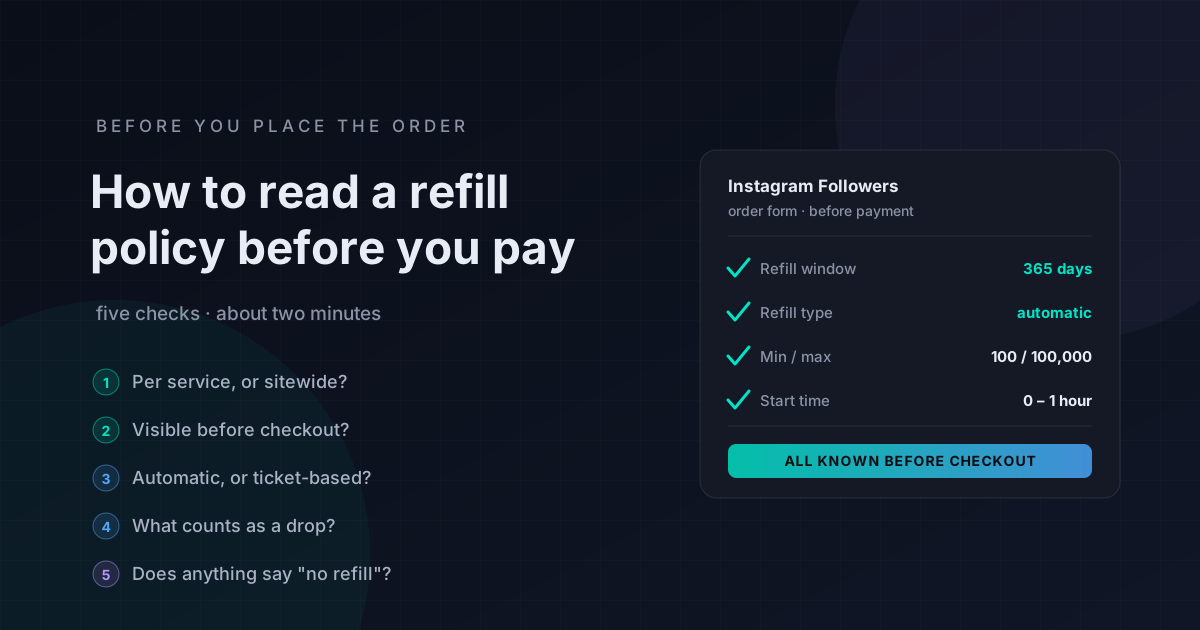
Do refill guarantees actually work?
On reputable panels, yes — refill windows of 30–60 days are honored because retention data is the panel's reputation. They work only if documented: screenshot your counts at delivery and at day 30, and file support tickets within the stated window.
Final thoughts
SMM panel safety is mostly a sourcing problem, not a luck problem. The buyers who lose money share a pattern — anonymous panels, big first deposits, no screenshots, passwords typed where they never belonged. The buyers who do fine share the opposite pattern: independent reviews first, test orders second, containment payments always, and written refill terms before any real spend. Follow the seven steps, respect the password rule, and treat verified track records as the price of admission for your budget.